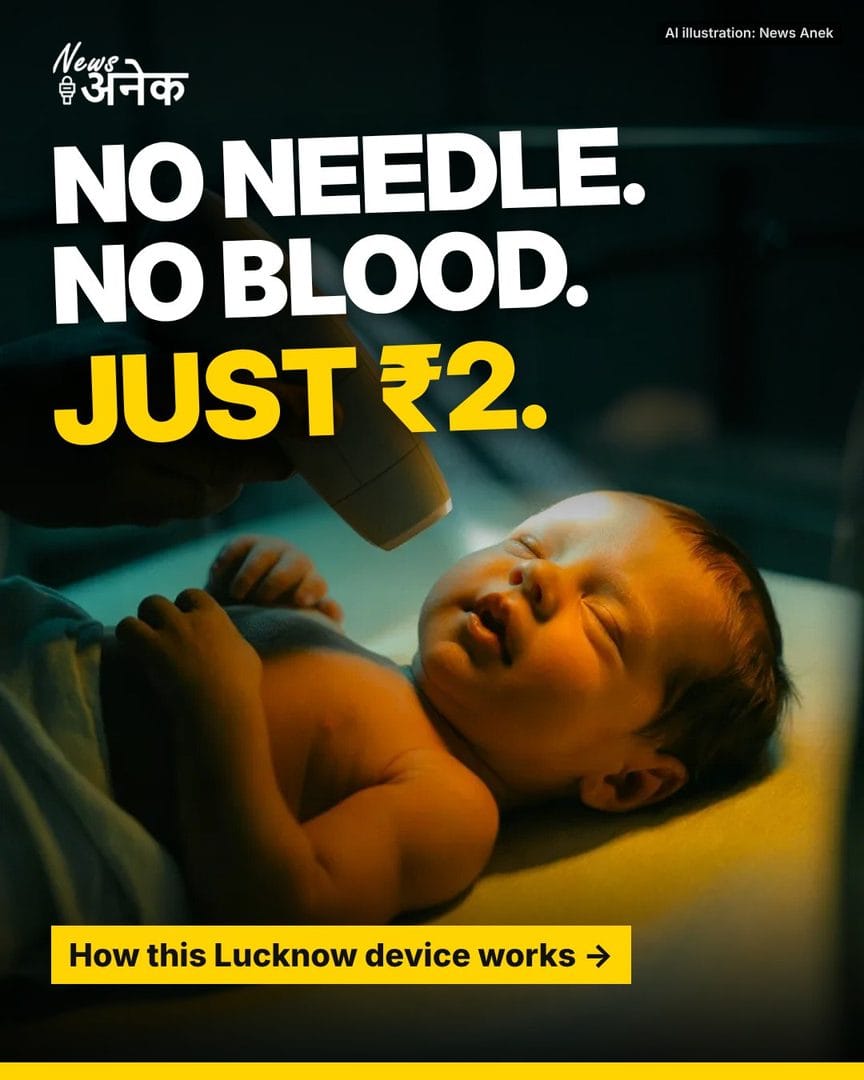
Ask any new parent in India about the first week at home with a baby, and there is a good chance the word "jaundice" comes up. A doctor notices a yellow tint on the baby's face. A heel is pricked. A tiny blood sample goes off to a lab, and the family waits.
In a big city hospital, that wait might be a few hours. In a small town or village, the nearest lab can be far away, and the wait can stretch much longer. A Lucknow startup thinks it has a better first step: a handheld device that checks for jaundice without drawing any blood at all.
What is BiliSURE?
The device is called BiliSURE, and it is made by Medblue Innovations, a medical-technology startup based in Lucknow. It is placed against a baby's skin and uses light to estimate how much bilirubin is in the body. Bilirubin is the yellow pigment behind jaundice.
How it works
The technique is called spectral analysis. In simple terms, the device shines light on the skin and measures how it bounces back. Skin with more bilirubin reflects light differently. BiliSURE combines that reading with AI to give an estimate of the bilirubin level, and shows the result straight away. No needle, no blood, no waiting for a lab report.
The company describes the device as affordable and Made in India, built for hospitals and clinics with limited resources.
The people and money behind it
Medblue was founded by Jitesh Pandey and Mansi Tyagi. The startup has been supported by NSRCEL, the incubator at IIM Bangalore, and was part of Pfizer's INDovation 2025 programme for healthtech startups.
The Government of India's science and technology portal lists the project as funded by BIRAC, the Biotechnology Industry Research Assistance Council, which works under the Department of Biotechnology. According to NSRCEL, BiliSURE was validated in five clinical settings and is now being used in three hospitals, one private and two run by the government.
Why newborn jaundice matters
Very common, usually harmless
Jaundice is one of the most common conditions in newborn babies. A baby's liver is still learning to clear bilirubin from the blood, so levels often rise in the first few days. The UK's National Health Service (NHS) says newborn jaundice is usually harmless and gets better on its own, typically within about two weeks.
But dangerous if missed
In a small number of babies, bilirubin climbs very high. If that is not spotted and treated, it can damage the brain, a condition called kernicterus, which can cause lifelong disability. Treatment is usually simple: phototherapy, where the baby lies under a special blue light. The hard part is catching the high cases in time.
That is where a quick, cheap screening tool could help. If a health worker can check a baby in seconds at home or in a primary health centre, the few babies who need a blood test and treatment can be sent on quickly, while the rest are spared a needle.
What BiliSURE cannot do
It is worth being careful here. BiliSURE is a screening tool, not a final diagnosis. A high reading still has to be confirmed with a blood test, and a doctor still has to decide on treatment.
Skin-based devices of this kind already exist internationally, and their accuracy can vary with skin tone and with how high the bilirubin level is. When we checked, we could not find large, independently published studies of BiliSURE's accuracy in Indian babies. That does not mean it does not work. It means parents and doctors should treat it as a first check, not the last word.
Signs every parent should know
Whatever test your hospital uses, these are the signs that mean you should get medical help quickly:
- Your baby turns yellow in the first 24 hours after birth.
- The yellow gets deeper, or spreads from the face to the chest, tummy, arms and legs.
- Your baby is unusually sleepy or is not feeding as well as usual.
- Your baby's urine is dark yellow, or the stools are pale.
A tip for darker skin
Yellowing can be harder to see on brown or black skin. Check the whites of the eyes, the gums and the palms of the hands and soles of the feet, and do it in good daylight.
The bigger picture
India has made real progress in bringing down newborn deaths, but many of the remaining risks are about time and distance. A device that can give a reasonable answer in seconds, without a lab, fits that problem well. If BiliSURE and tools like it hold up in wider use, the biggest gains will not be in city hospitals. They will be in the places where the nearest lab is a bus ride away.
This article is for general information only. It is not medical advice. If you are worried about your baby, speak to a doctor.