For months there were reports, whispers and denials. Then, on 22 October 2026, the man in charge of guarding India's border with China said it out loud.
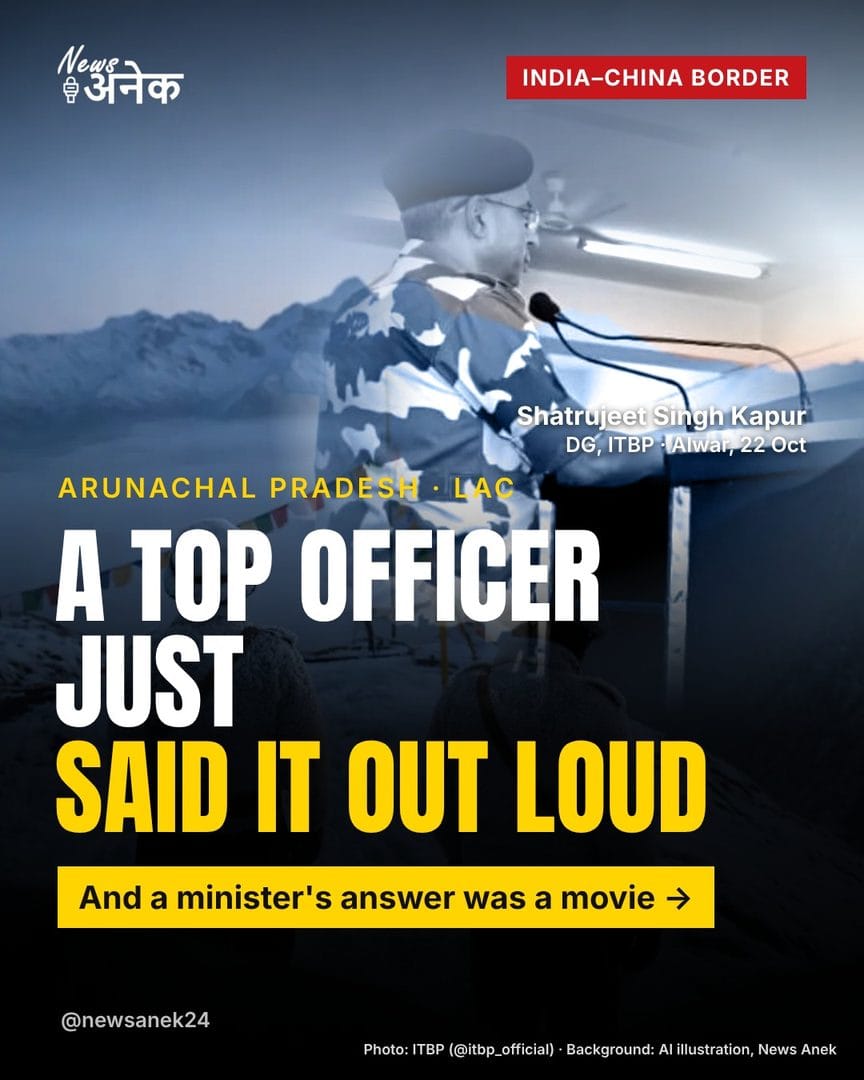
Speaking to his troops at an Indo-Tibetan Border Police (ITBP) event in Alwar, Rajasthan, Director General Shatrujeet Singh Kapur said face-offs with Chinese troops had taken place at several locations in Arunachal Pradesh, and that they were still going on. Some, he indicated, were unresolved.
It was the first time a top security official had publicly confirmed what had been reported since the summer. Within a day, it had become a political storm.
What the ITBP chief said
Kapur's remarks were not made at a press conference. They came in a speech to his own force, the kind of address where a chief praises his men and talks about the challenges ahead. He spoke about the confrontations in Arunachal and credited the ITBP's newly raised "Shaurya" commando teams for the way they had handled them.
That context matters. Kapur was not making a policy statement on behalf of the government. He was describing, to the people doing the job, what the job currently involves. But once his words were reported, they carried the weight of an official admission.
Who is Shatrujeet Kapur?
Kapur is a 1990-batch IPS officer of the Haryana cadre. He took charge of the ITBP in January 2026 and retired on 31 October 2026, barely a week after the Alwar speech. Sashastra Seema Bal (SSB) chief Sanjay Singhal has been given additional charge of the ITBP until a full-time chief is appointed.
Where the face-offs are happening
According to reports, the face-offs began in late July 2026 near Taksing in Arunachal Pradesh's Upper Subansiri district. Indian and Chinese patrols are said to have come face to face near an area called Maja during routine patrolling. Reports also say the stand-offs carried on in September, even while Chinese President Xi Jinping was in India for the BRICS summit.
Upper Subansiri is remote, mountainous country, close to the McMahon Line that India treats as its border with Tibet. China does not accept that line and claims much of Arunachal Pradesh as its own territory, calling it "South Tibet". That old dispute is why patrols from both sides regularly run into each other in this region.
What a "face-off" actually means
The word can sound dramatic, but on the Line of Actual Control (LAC) a face-off usually means two patrols meeting in an area both sides consider theirs. Each tells the other to leave. Banners are sometimes held up. Most such meetings end without violence, under protocols the two countries agreed in the 1990s and 2000s. The danger is that a stand-off which drags on for weeks can escalate, as it did in Galwan, Ladakh, in June 2020, when 20 Indian soldiers were killed.
The political reaction
On 23 October, Congress general secretary Jairam Ramesh accused Prime Minister Narendra Modi of a "deafening silence" on the face-offs. In a post on X, he praised the ITBP chief's frankness and contrasted it with what he called the government's "calibrated concessions" to China.
Ramesh also alleged that Indian patrolling points had been lost, as he said had happened in Ladakh, and pointed to India's trade deficit with China, which he put at a record $112 billion in 2025-26. Congress president Mallikarjun Kharge called the DG's confirmation "deeply alarming".
And the government's side
Reports differ on whether the Centre has formally responded to Kapur's remarks. Some say the government has made no public comment. Others report that it has repeated its long-standing position that Arunachal Pradesh is an "inalienable" and "integral" part of India.
A sharper, more colourful response came from Arunachal Pradesh itself. On 28 October, state minister Balo Raja said "India is very strong" and told doubters to watch Dhurandhar, the 2025 spy thriller, to see how far India's intelligence capabilities have come. He also said differences with China should be resolved through dialogue.
Why this matters
India and China spent four years in a tense military stand-off in eastern Ladakh after Galwan, before the two sides reached a patrolling agreement in October 2024. Relations have slowly thawed since then, with more trade, direct flights and high-level visits.
That is why a confirmation of fresh face-offs in the east is significant. It suggests that the calm in Ladakh has not translated into calm all along the 3,488-km frontier. It also raises questions about how much the public is told, and when. Much of what is known about the Arunachal face-offs came from reports, not official briefings, until a retiring police chief spoke to his own troops.
What we still don't know
Plenty of questions remain open:
- Exactly how many points in Arunachal are affected, and whether any have been resolved since October.
- Whether India has lost access to any patrolling points, as the opposition alleges.
- What, if anything, China has said about the face-offs.
- Whether the Ministry of External Affairs or the Army will give a fuller briefing.
We will update this story as official information becomes available.
Sources
- The Pioneer: ITBP chief confirms ongoing China face-offs in Arunachal
- ThePrint: 'Deafening silence': Congress slams PM on reported Arunachal face-offs
- ThePrint: Arunachal minister Balo Raja cites Dhurandhar
- Free Press Journal: Who is Shatrujeet Kapur?
- The Secretariat: SSB chief Sanjay Singhal gets additional charge of ITBP