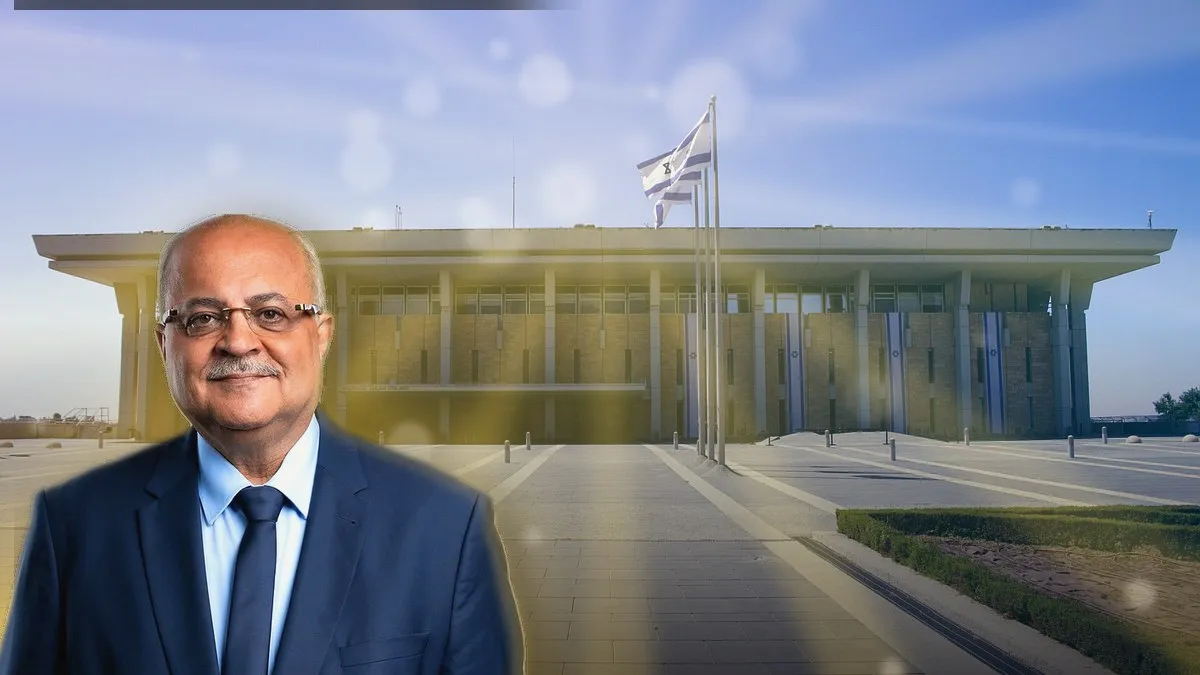
Israel's parliament, called the Knesset, has elected Ahmed Tibi as its deputy speaker. Tibi is an Arab lawmaker.
He leads the Ta'al Party, which is part of the Joint List.
At the same time, Avigdor Lieberman will serve as chairman of the Knesset. He heads the right-wing Yisrael Beiteinu party.
The Knesset's Foreign Affairs and Defense Committee announced this on Monday.
Key points
- Ahmed Tibi, an Arab lawmaker, is now deputy speaker of the Knesset.
- Avigdor Lieberman, of the right-wing Yisrael Beiteinu party, will chair the Knesset.
- The Joint List and Ra'am together won 19 seats in last month's election.
- The Joint List alone won 11 of those seats.
Why does this result matter for these parties?
The Joint List and the United Arab List, called Ra'am, both represent Palestinian citizens of Israel.
In last month's election, they made historic gains. Here, historic means a result that stands out in their own history.
Their combined total was 19 seats in parliament. The Joint List held 11 of them.
Graphic: News Anek, from the facts in this report
Tibi called this a rightful achievement for the alliance.
What did Tibi say about his election?
Tibi said the Joint List will be represented in all committees.
Committees are small groups of lawmakers who study issues in detail.
He also said that Netanyahu's Likud party and national security minister Itamar Ben-Gvir tried to stop his election.
He said they failed.
What happens next with government talks?
The bloc of these parties backed Gadi Eisenkot.
President Isaac Herzog earlier this month asked him to form Israel's next government.
So Eisenkot now has the task of forming that government.
The Joint List's place on every committee is the next step Tibi has confirmed for his party.
Explainer
What happened before
- Parties representing Palestinian citizens of Israel won a combined 19 seats in last month's election.
- Earlier this month, President Isaac Herzog tasked Gadi Eisenkot with forming Israel's next government.
Why it matters
It shows a bigger role for parties representing Palestinian citizens of Israel in the country's parliament.
What to watch next
- The Joint List will be represented in all committees, Tibi said.
- Eisenkot now has the task of forming Israel's next government.
Exam Corner
UPSC GS Paper 2 · International relations: Israel's parliament
What's the news
Ahmed Tibi was elected deputy speaker of Israel's Knesset, and Avigdor Lieberman will serve as its chairman.
Background
- Parties representing Palestinian citizens of Israel won a combined 19 seats in last month's election.
- The Joint List alone won 11 of those seats.
- President Isaac Herzog earlier this month tasked Gadi Eisenkot with forming Israel's next government.
Facts for Prelims
- The Knesset is Israel's parliament.
- The Joint List won 11 seats in the latest election.
- The Joint List and Ra'am together won 19 seats.
Content for Mains
- Significance: Greater representation of minority parties can strengthen inclusion in parliamentary institutions.
- Main issue: Political divisions can make coalition building and committee roles contentious.
- Challenges: Parties from different communities may struggle to find common ground on policy.
- Way forward: Inclusive parliamentary practices and consensus-building can help stable governance.
Practice question: Examine how the representation of minority parties in a legislature can shape government formation and parliamentary functioning.
Prelims practice questions
Q1. Who was elected deputy speaker of Israel's Knesset?
- Avigdor Lieberman
- Ahmed Tibi
- Isaac Herzog
- Gadi Eisenkot
Show answer
Answer: B. The article states that Ahmed Tibi was elected deputy speaker of the Knesset.
Q2. How many seats did the Joint List win in last month's election?
- 7
- 19
- 4
- 11
Show answer
Answer: D. The article says the Joint List secured 11 seats, while 19 is the combined total of the Joint List and Ra'am.
Key terms
- Knesset: The parliament of Israel.
- Deputy speaker: A senior lawmaker who assists the chairman in running the work of parliament.
- Forming a government: The process of building a ruling group of parties after an election, often when the president or head of state asks a leader to try.
More stories for exam preparation: UPSC Today
These points come from this news report. Check them with standard sources such as NCERT books and PIB before your exam.